Executive profile
A senior decision-maker balancing travel, meetings, information requests, and limited attention.
Designing a voice-first intelligent assistant for executives years before conversational AI became mainstream.
Enterprise Voice Assistant was designed to help executives and senior managers retrieve information, plan business travel, compare flights and hotels, organize itineraries, and complete complex administrative tasks through natural voice interaction.
The project went beyond interface design. It explored how an intelligent system should understand intent, manage context, communicate decisions, and behave predictably while helping people accomplish real work.
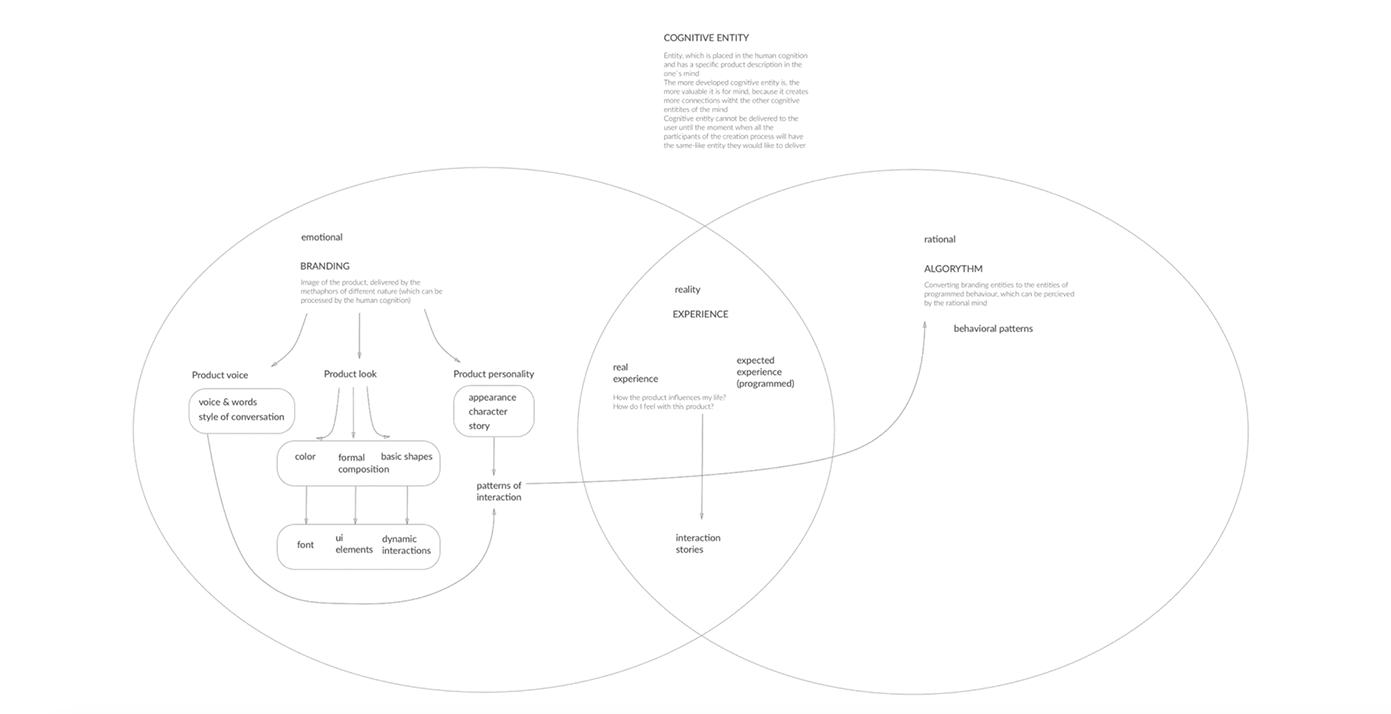
The cognitive-entity model connecting product identity, experience, and behavioral logic.
Executives and senior professionals frequently work across calendars, email, booking platforms, travel services, corporate information systems, and administrative workflows.
A single business trip might require searching for flights, comparing arrival times, evaluating hotels, considering location, coordinating meetings, and assembling a complete itinerary.
Enterprise Voice Assistant was designed to reduce that fragmentation. Users could express a goal through natural voice interaction, while the assistant helped retrieve relevant information, compare options, preserve context, and guide the task toward a useful outcome.
The goal was not simply to answer isolated questions. It was to support multi-step tasks in which each new decision depended on information established earlier in the interaction.
The research identified three primary user profiles with different routines, responsibilities, communication styles, frustrations, and expectations of intelligent assistance.
A senior decision-maker balancing travel, meetings, information requests, and limited attention.
A professional coordinating multiple responsibilities and requiring fast access to structured information.
A user completing complex administrative and planning tasks across several tools.
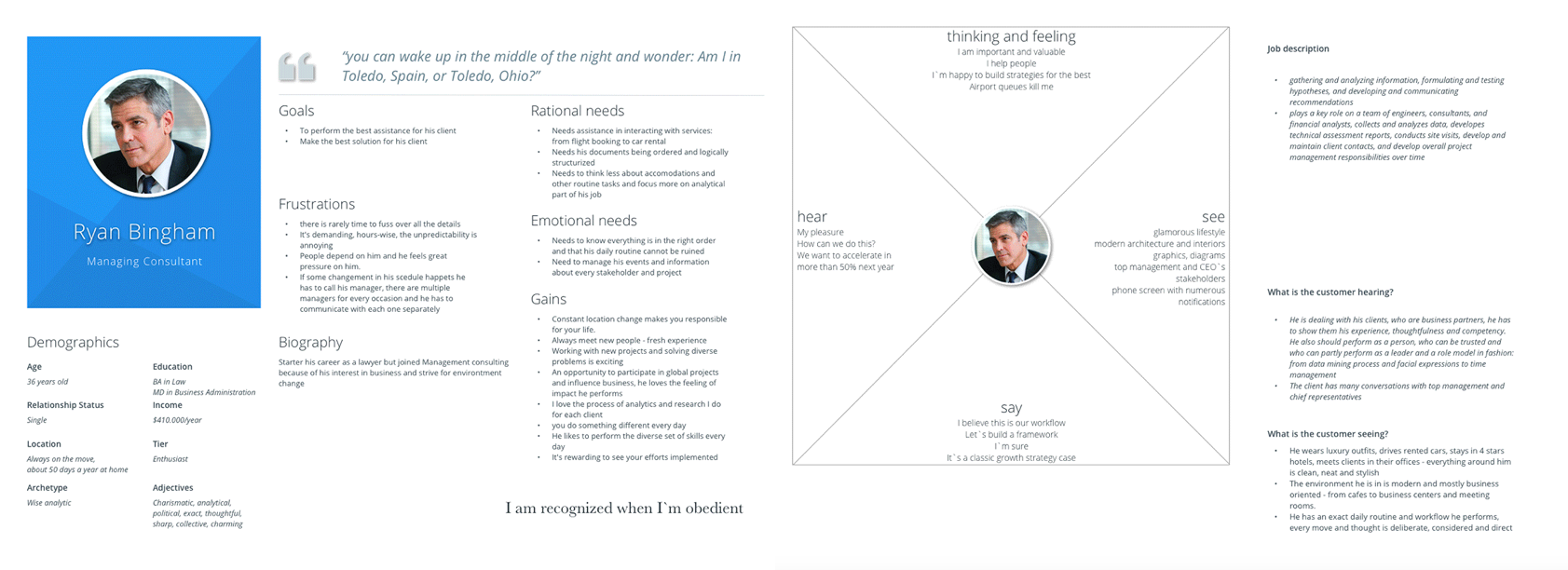
Persona 01 — full user profile, daily context, goals, behaviors, and pain points.
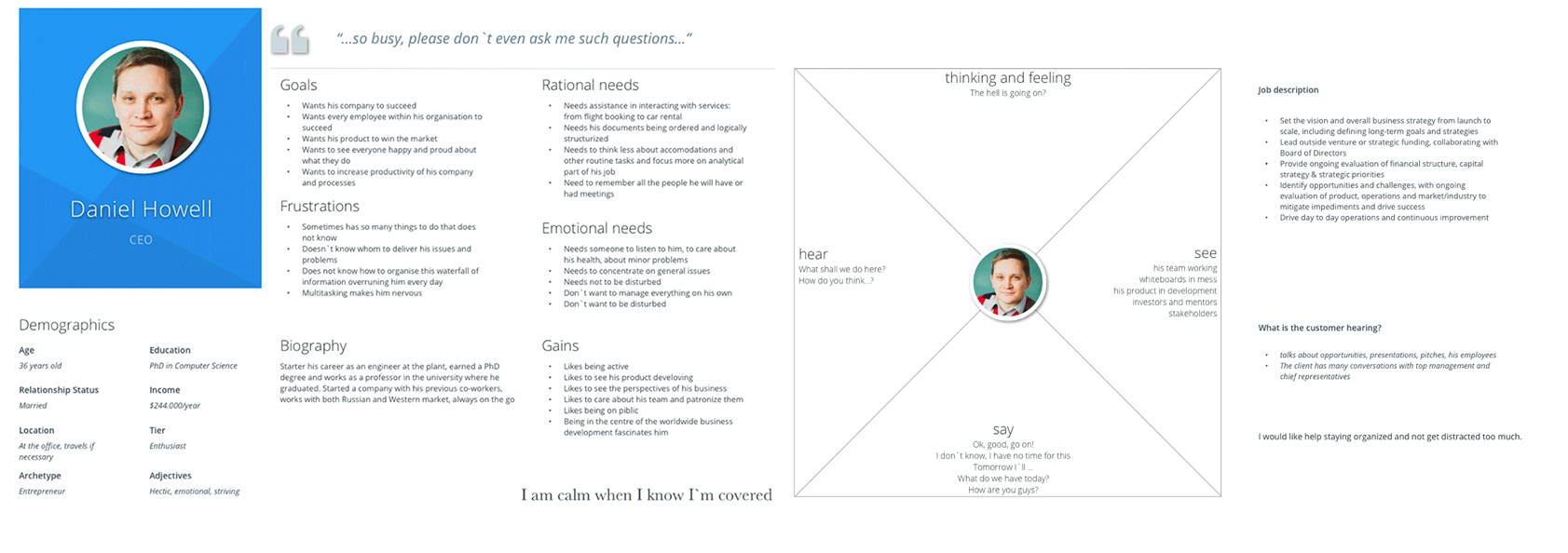
Persona 02 — full user profile, daily context, goals, behaviors, and pain points.
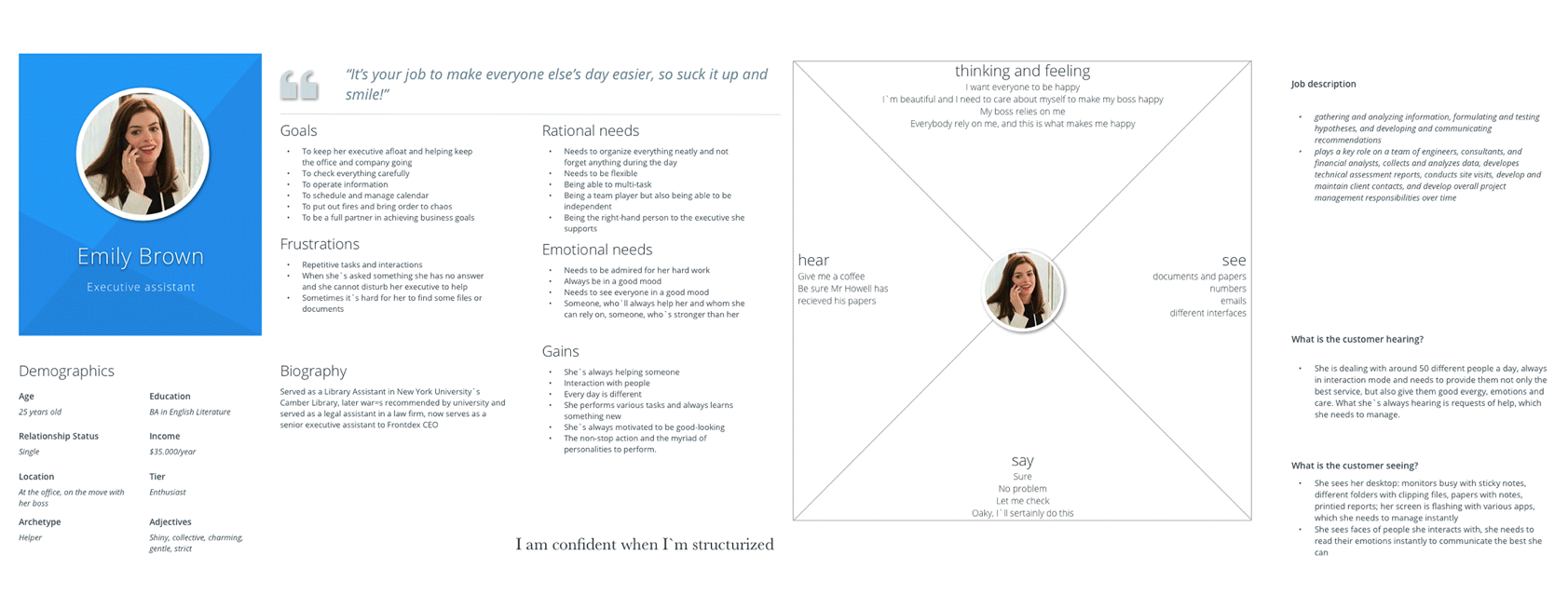
Persona 03 — full user profile, daily context, goals, behaviors, and pain points.
After identifying the three user profiles, I explored the broader context surrounding their work.
The research documented a typical working day; responsibilities and job context; recurring frustrations; what users saw and heard; what they thought and felt; what they said and did; the information they depended on; and who they became when interacting with the product.
The objective was not to create personas as presentation artifacts. It was to understand the conditions under which an intelligent assistant would need to communicate, interrupt, recommend, clarify, and remain silent.
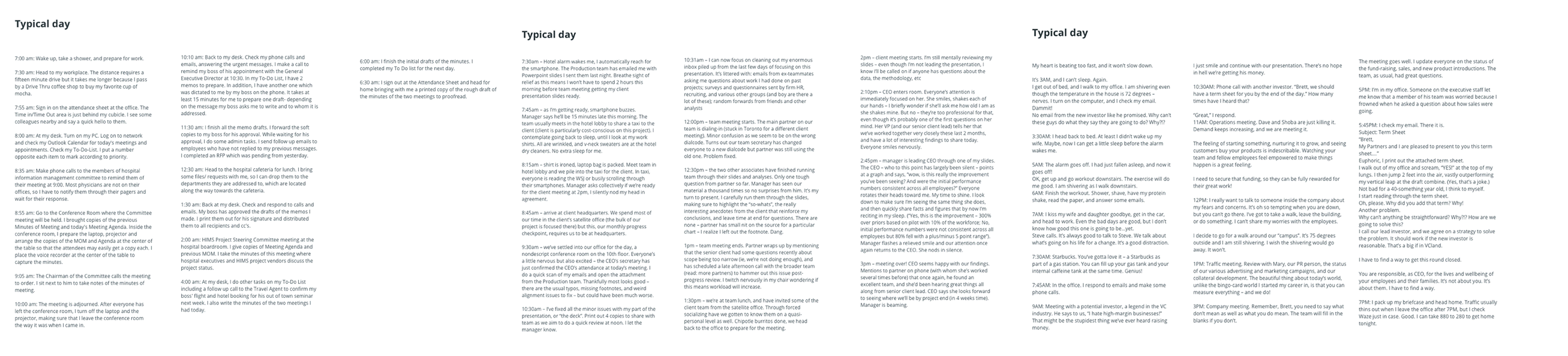
Typical working day — the routines and pressures surrounding assistant use.
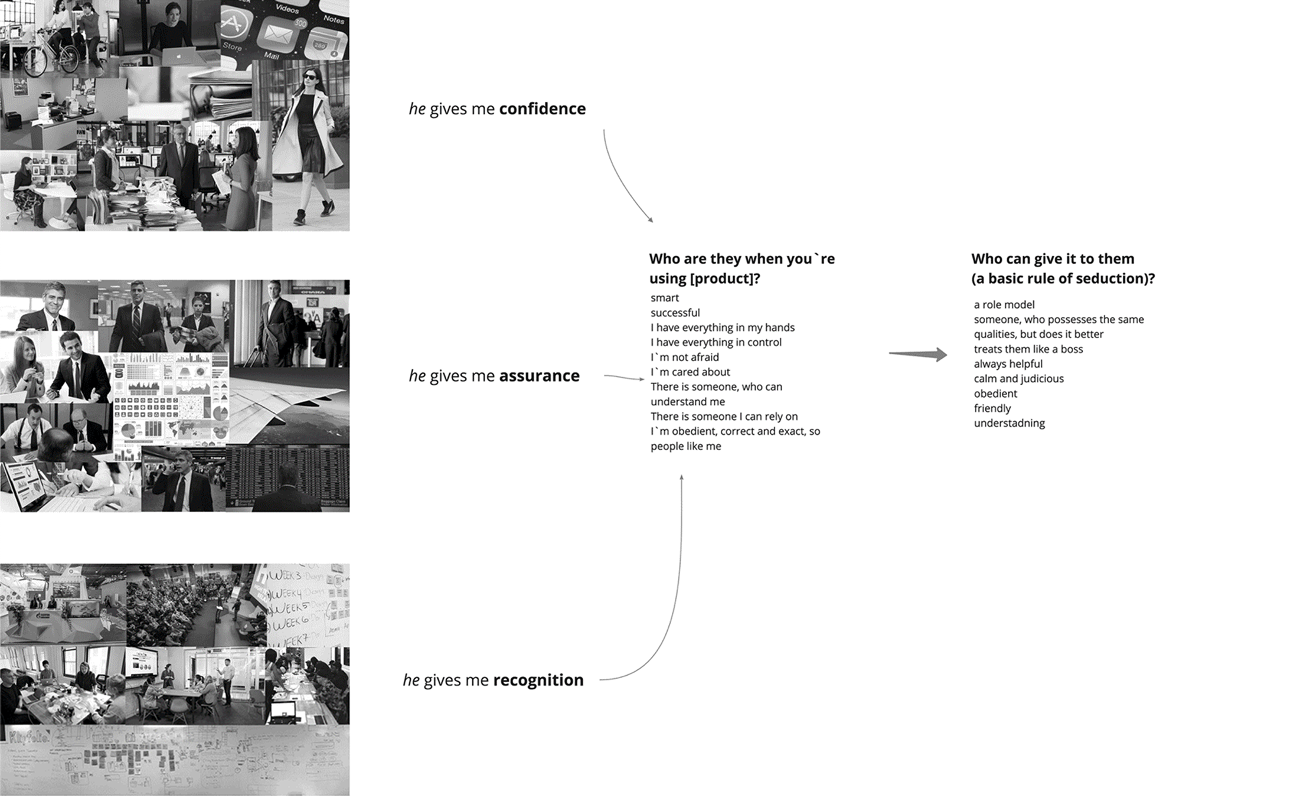
Product-use profile — behavior and expectations within the assistant relationship.
Before defining individual conversations, I created a complete profile of the assistant itself.
The system was treated as an entity with a specific role, identity, communication style, responsibilities, knowledge boundaries, values, and behavioral characteristics.
This product image helped establish what users could expect from the assistant and created a foundation for consistent behavior across different tasks.
Before designing what the assistant would say, I defined what kind of system it was.
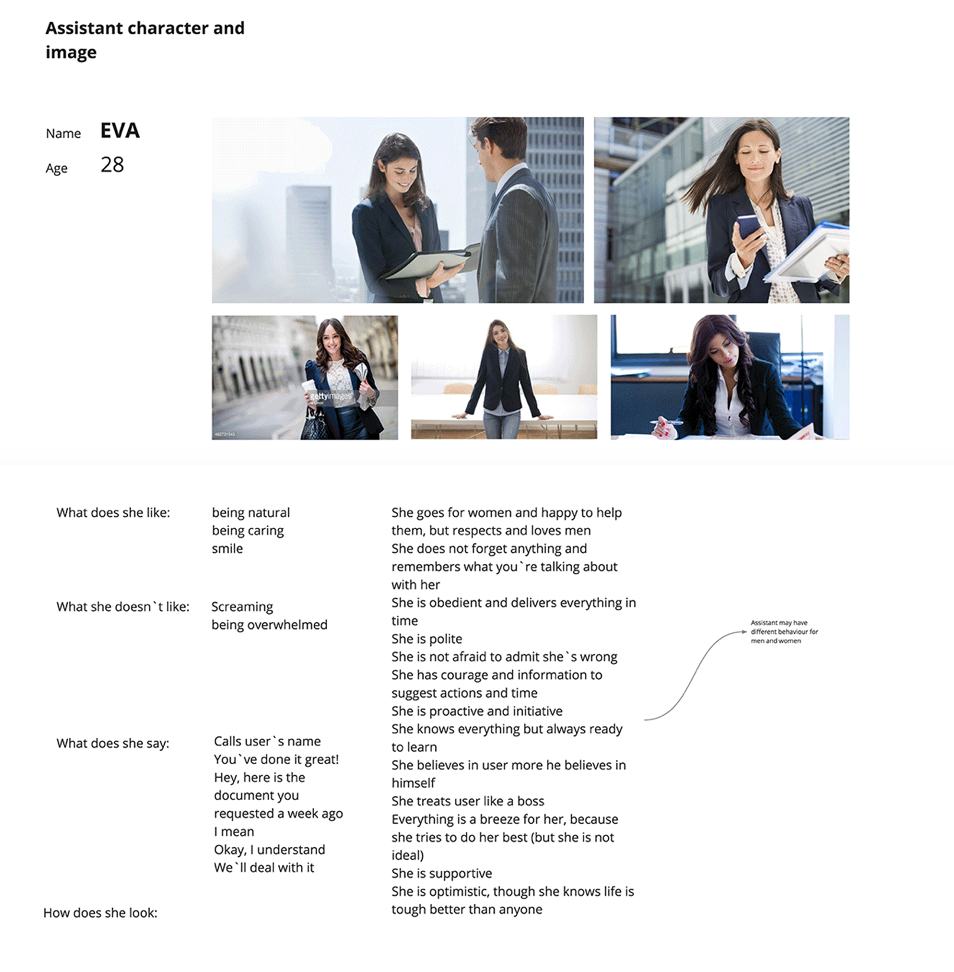
Defining the assistant’s identity, role, communication style, and behavioral expectations.
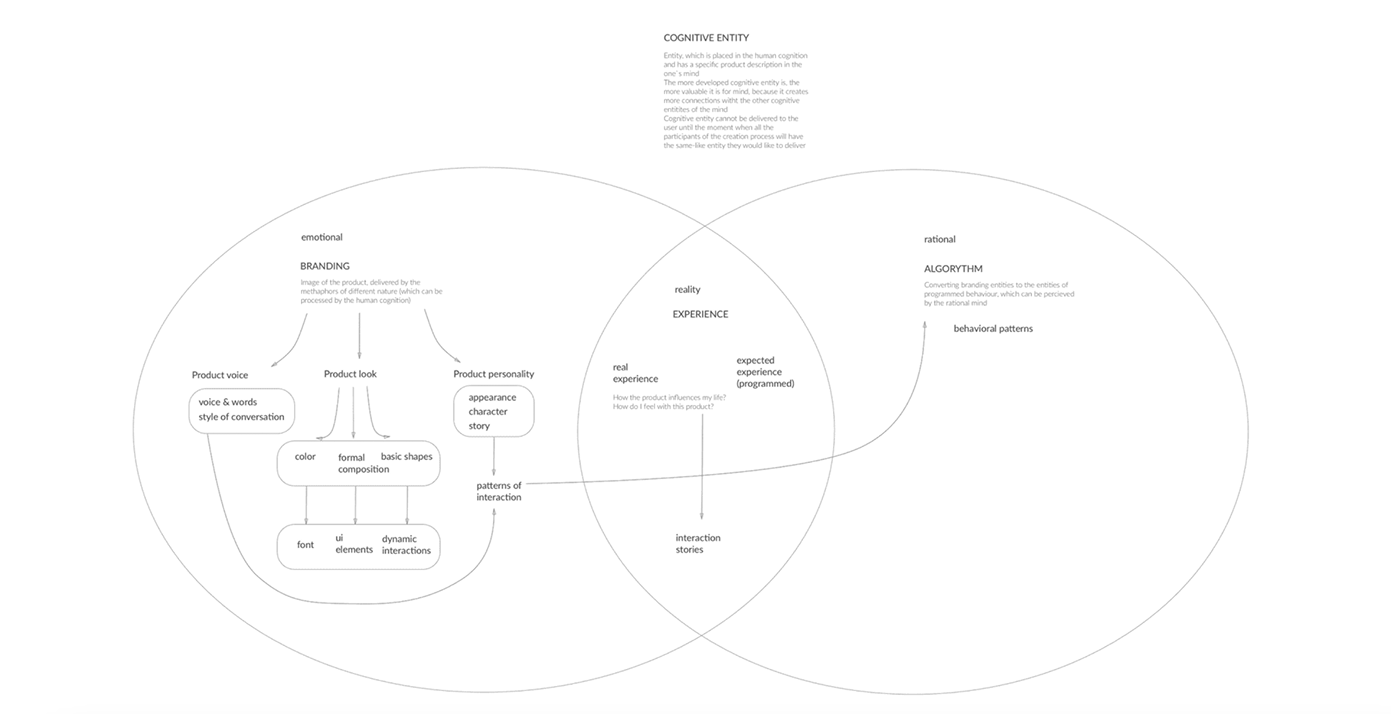
The complete cognitive profile used as a foundation for later interaction decisions.
The assistant needed to support complex, multi-step tasks rather than answer disconnected prompts.
I developed behavioral algorithms describing how the system should interpret the user's objective; identify missing information; maintain relevant context; decide when clarification was necessary; organize and compare options; communicate recommendations; and move the user toward task completion.
These schemes represented the logic behind the interaction rather than a script of predetermined phrases.
Conversation was the visible layer. Decision logic shaped everything underneath it.
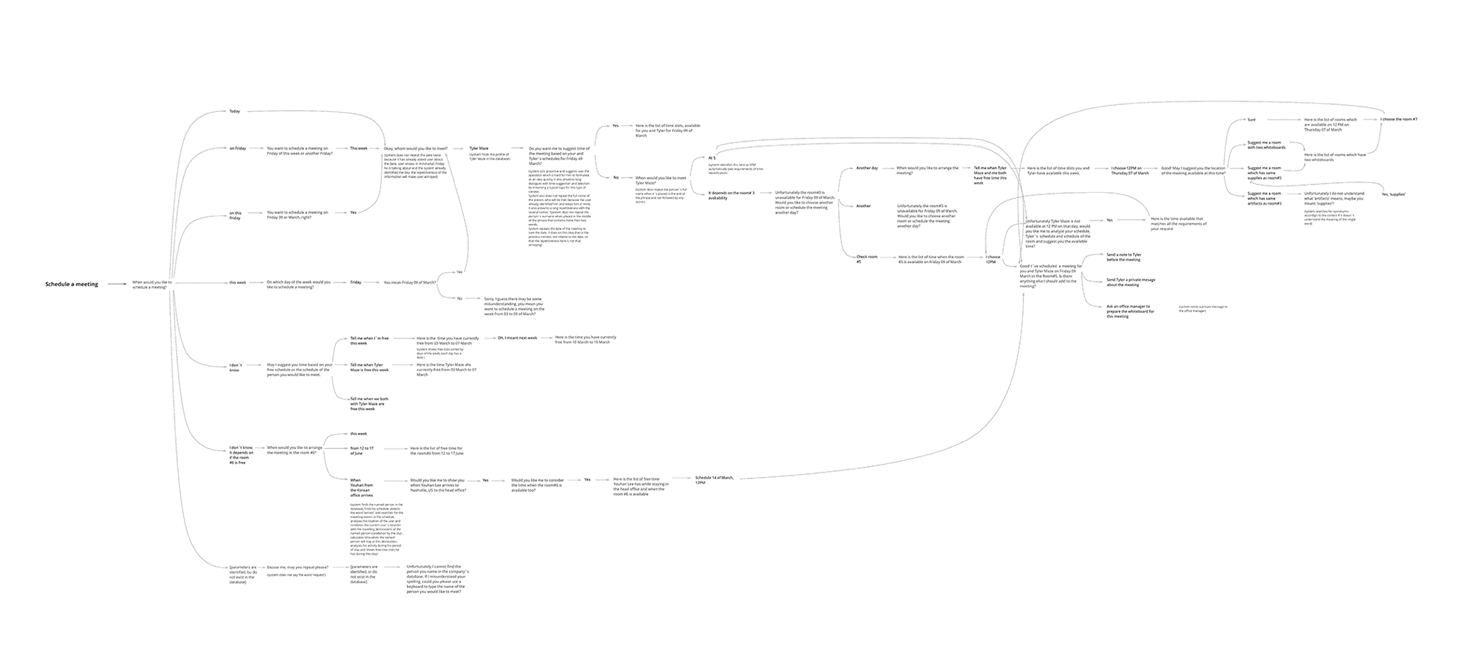
The behavioral model describing how the assistant interpreted context and progressed through a task.
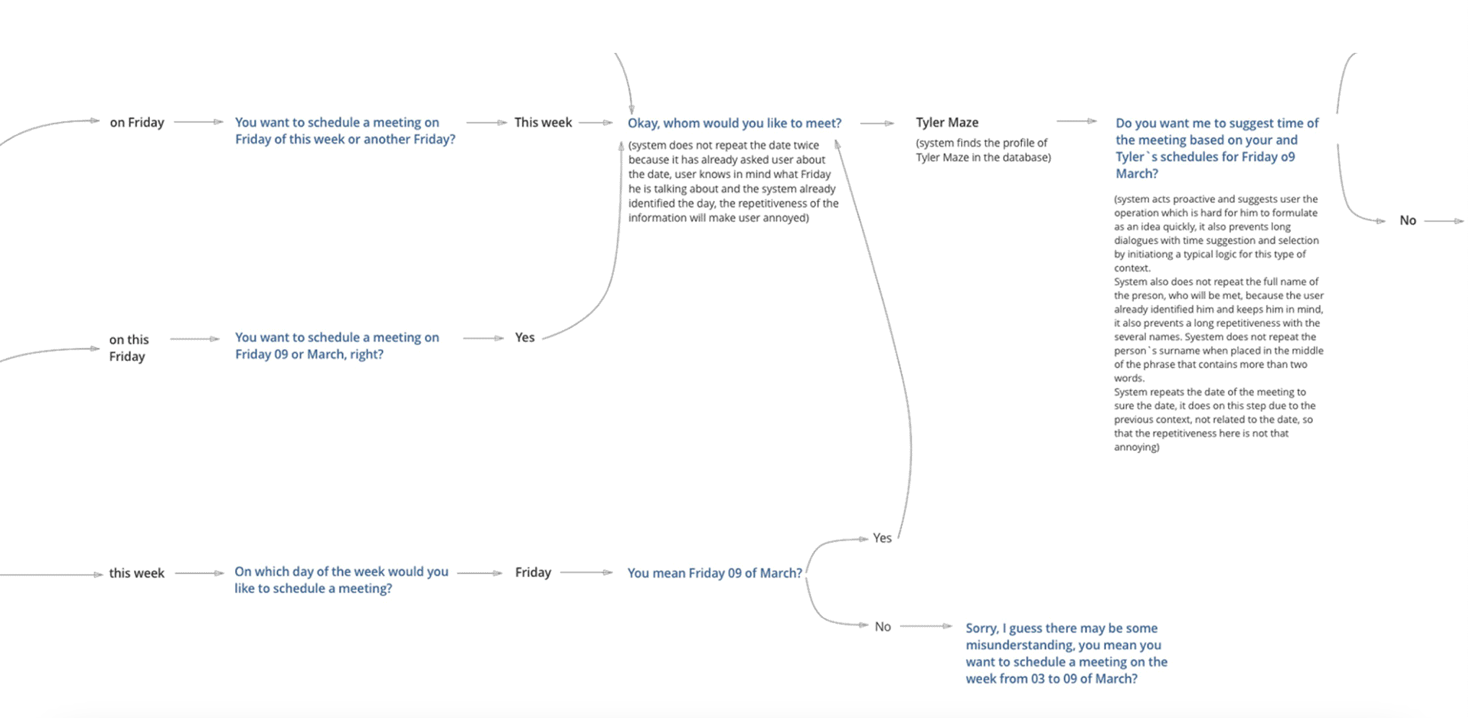
Decision logic defining how the system selected actions, requested clarification, and communicated outcomes.
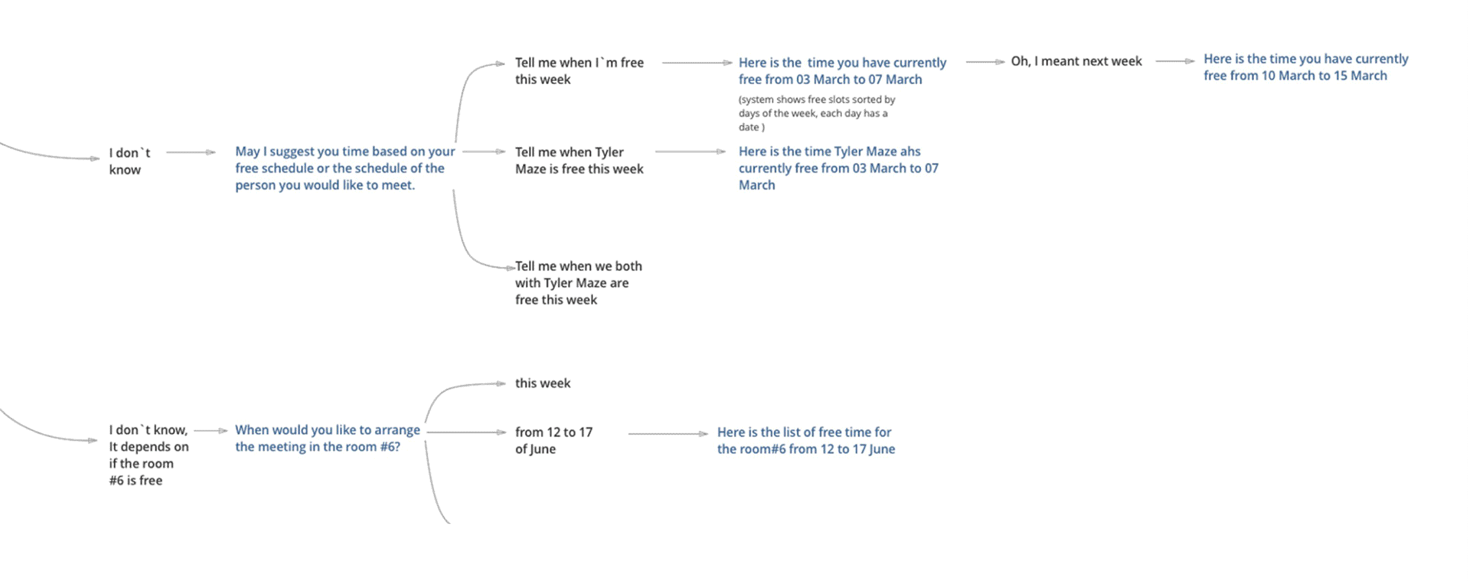
Behavior flow — clarification and context handling across a continuing scheduling interaction.
Every interaction was guided by explicit principles intended to make the assistant consistent, understandable, and useful across different scenarios.
The system needed to support the user without becoming unpredictable, unnecessarily conversational, or difficult to control.
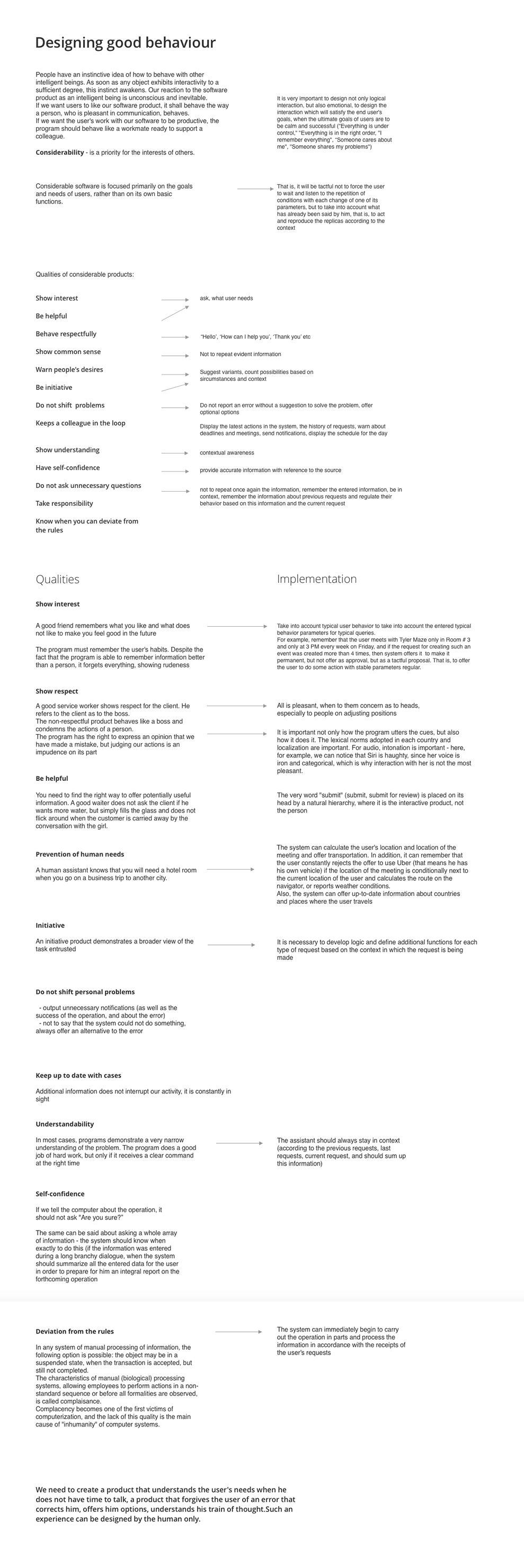
A complete framework defining the principles of useful and trustworthy intelligent behavior.
Only after the user context, system identity, behavioral principles, and decision logic had been established did interface design begin.
The wireframes explored how a voice-first assistant could communicate progress, preserve task context, present choices, and support complex travel-planning scenarios without overwhelming the user.
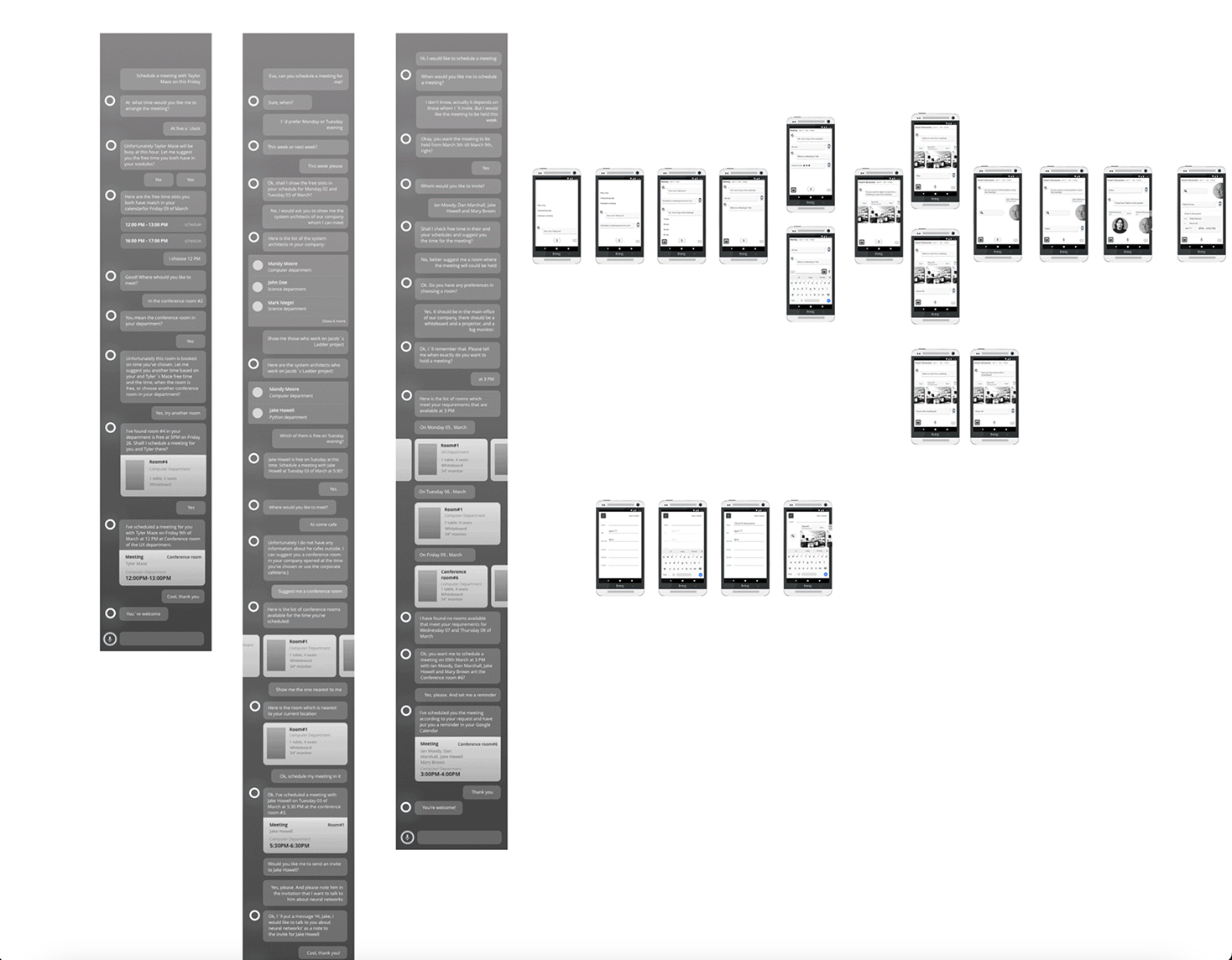
Wireframes tested how behavioral principles translated into task-oriented interaction.
The assistant also needed a recognizable product identity.
The visual concept translated its intended personality into typography, color, interface hierarchy, and brand expression, creating consistency between how the system behaved and how it appeared.
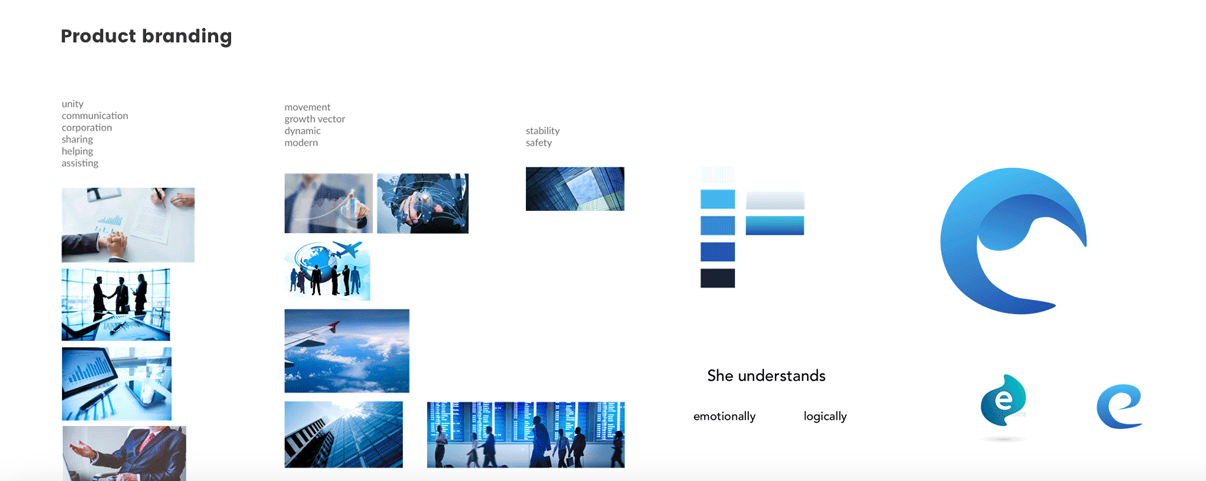
The visual identity made the assistant’s intended personality tangible.
The interface became the visible expression of the user context, system identity, behavioral rules, decision logic, and conversation architecture established earlier.
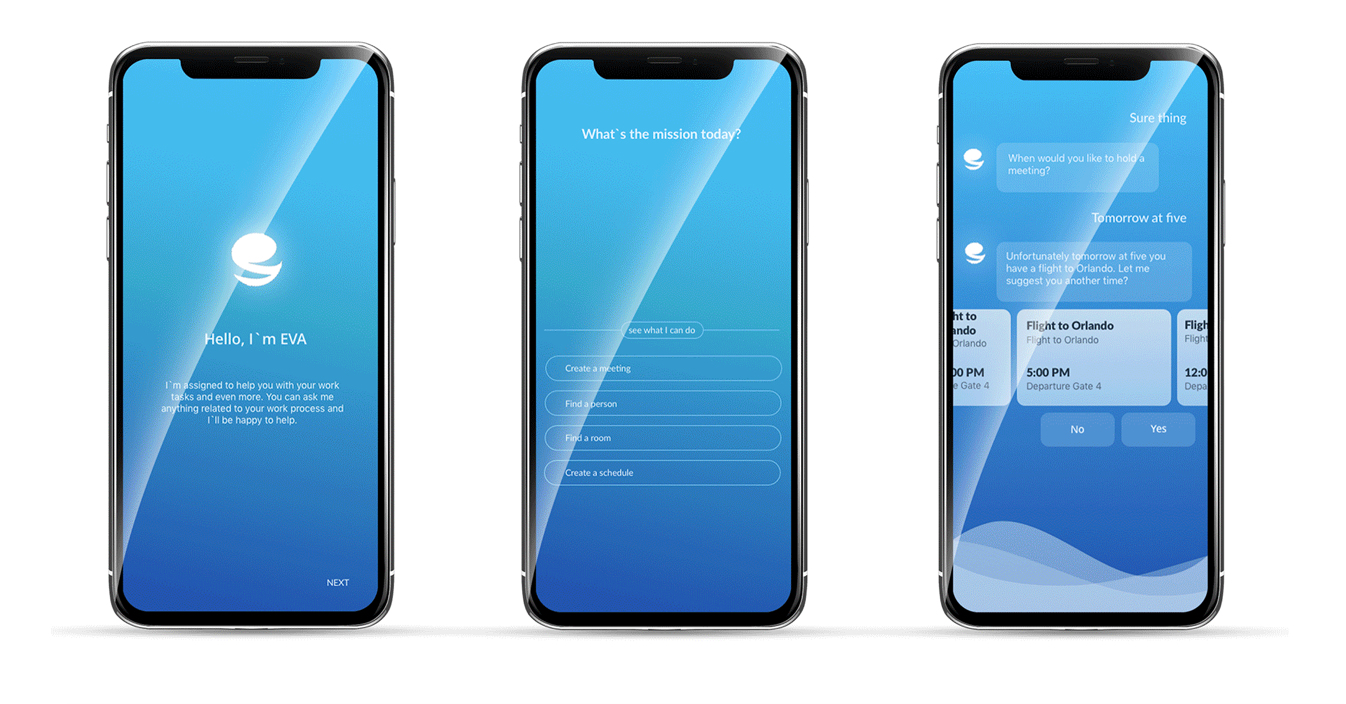
Final UI — the assistant translated behavioral logic into a focused mobile interaction.
This project was created 8 years before today's LLM-powered products.
Looking back, many of the questions explored throughout this work—behavior, trust, decision logic, context, transparency, and human-AI collaboration—have become central challenges in contemporary AI product design.
Although today's technology is dramatically more capable, the underlying interaction principles remain remarkably relevant.
This project represents an early exploration of Human–AI Interaction long before conversational AI became widely adopted.
Designing AI-assisted mental healthcare experiences.